In integral education, language proficiency at a young age is an essential part of their training.
Below is a round-up of some of the classroom exercises for 8-9-year-olds. Please read here (link coming up soon) for detailed implementation of the value-based English curriculum implementation.
Naming words (nouns), action words (verbs), tenses
- Collect the names of all the objects and actions used in the kitchen, living room, bedroom, and bathrooms.
- Underline/ circle the naming words and action words in the paragraphs they read.
- Go on a nature walk and ask them to write and learn new nouns and verbs.
- Forms of verbs in different tenses starting with the present tense, following the near-to-far principle. Help them write reflections in one particular tense.
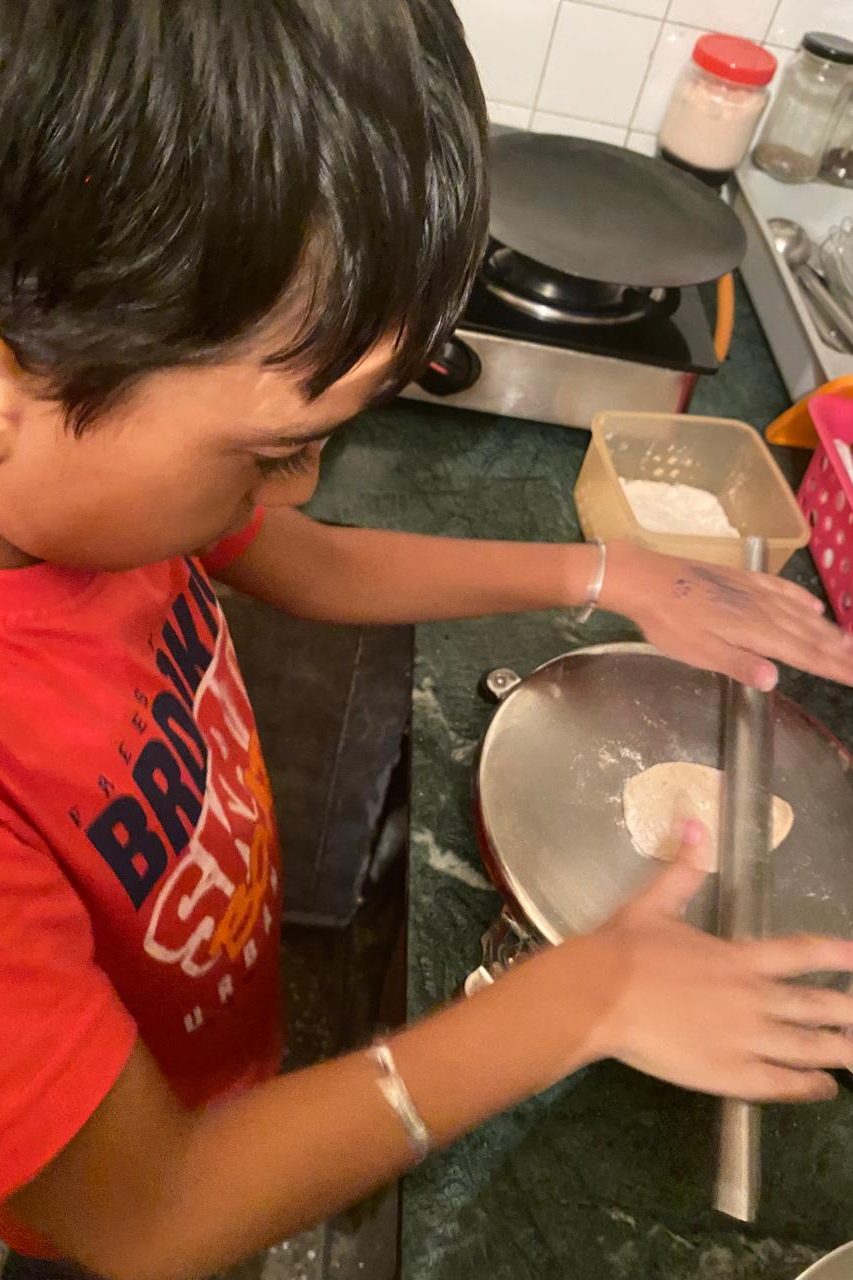
- Do a live cooking session with the kids and ask them to write the recipe. All the kids made Oregano roti in class and wrote it up. A video of the peanut-sesame-coconut powder recipe they enjoyed along with the roti was given sent as a home assignment. Children also tried their hand at making roti at home just like the little one below.
Adjectives and Adverbs
- Classify the adjectives based on color, size, shape, temperature, etc.
- Circle the adjective and the corresponding noun that it describes in simple sentences. (Same with adverbs)
- Give a black and white picture, ask them to color it, and then use adjectives to describe it. See the example below.
- Order-of-words discussion: A nice cup of tea vs a cup of nice tea.
- Brainstorming Around Central Words. Sweater → black, warm, etc. Black → hair, clouds, etc.
- Underline the adjectives and circle the corresponding words that they describe.
The day was radiant, with golden sunshine streaming across the backdrop of the crystal-clear blue sky. A gentle, refreshing breeze carried the sweet fragrance of the blooming, vibrant spring flowers across the lush, emerald-green meadows. Birds sang melodious, cheerful tunes that echoed through the tranquil, picturesque landscape, while the shimmering, sparkling river flowed gracefully under the warm, comforting glow of the afternoon light. Every moment felt serene, joyful, and enchanting, painting the world in vivid, dazzling colors that made the day feel truly magical. What a perfect day for me to find the elusive key to my grandfather’s treasure chest.
“Trrrrr!” The heavy chest popped open. “Just a piece of paper?!”
“Oh no! It is a map. I don’t know how to read this complicated map! Which side is up, which side is down?”
Continue the story! Identify the parts discussed in the class.

Prepositions indicate a relationship between two objects
Car on the road, A cup on the table, etc.
- Varying degree of specificity in {In, on, at}
- By, for, of usage in different contexts. We started with “By the people, For the people, Of the people” because the children were working on the Indian constitution.
Pronouns, Articles
- Ravi has ___ umbrella and __ raincoat in his bag.
- __ ancient banyan, with its roots twisting like giant serpents, ______ majestically in ___ Varaha temple’s courtyard.
- Take a paragraph, deliberately change the pronouns. Ask the children to find the mistakes in the pronouns in a paragraph.
- Draw parts of a picture and ask them to use demonstrative pronouns as you keep adding details to it. This exercise was also an absolute hit.
Conjunctions
- Look at the list here and start with the ones referring to time. Include ‘before’, ‘after’, etc., in the tense exercises.
- Provide different types of conjunctions and encourage them to use them in their reflections. Include it in the word list in creative writing exercises.
Framing questions:
- Write a sentence and underline a naming word. Ask them to write a unique question that gives that specific answer.
- Give five ‘yes or no’ questions to guess the object. Guess the word below.
Is it a living being? Yes. Does it live in water? Sometimes. Does it sleep at night? Yes. Can it walk? No. Does it bear fruit? Yes, sometimes.
Learning to give specific information
- Write an invitation to invite your family to a school celebration.
- Give a passage and then ask them to provide specific information in a sentence. This exercise was an absolute hit.
- {Rumbled, why}: My stomach rumbled because I was hungry.
- {Schoolyard, what}: We run 5 laps around the schoolyard before we play sports.
Creative writing sessions combined with spelling drills
How do you help children spell better in a language with no fixed spelling rules? In languages like English, their eyes have to see what they hear. Start with two-syllable words and increase the complexity over time. Encourage them to write an idea using the same words.
- Pattern-based spellings (words ending in -tion, -ence, -ment, etc.), including a 2-minute recall (Write 5 words on the board, make them observe the spelling, erase it and ask them to recall).
- Same beginning/ending word groups: Take a bunch of word chains, rhyming or otherwise, and ask them to use them in a creative story. To make it hard, give the first line.
- Unjumble words with similar endings.
- Write many 3- and 4-syllable words from long words.
Math-related exercises:
1. Connect symbol recognition to linguistic understanding
- Addition concepts: “jorna, milna” in Hindi
- English keywords: increase, add, join, deposit
- Subtraction concepts: “ghatana” meaning reduction
- English keywords: give away, reduce, remove, decrease, withdraw, katna
- Multiplication concepts: “bar bar jodna, gunitha” (repeated addition), scaling
- Practical examples: two boxes of apples, five repetitions of a six-step sequence, 1 cup of rice for two people, how much should we make for 5?
- Division concepts: “bar bar ghatana, barabar karna, vibhajan karna”
- English keywords: share equally, distribute equally, divide equally
2. Word problem framing exercises using different operators. Write a problem for (2*3)+5, (5+(3*5))/2.
If you chose to try any of these, do drop a note!
श्रीकृष्णार्पनमस्तु|




 ज्ञीप्सा /jñĪpsA/
Leave a comment