Last afternoon, I was watching my son practicing diligently the words he learned at school—kamal, kalash, kalam. In their school, language is through the usage of words. Just as we learned our first language, they use words to teach the letters of the alphabet. That triggered the memory of the first Tamil word I remember having learnt as a child — அறம்.
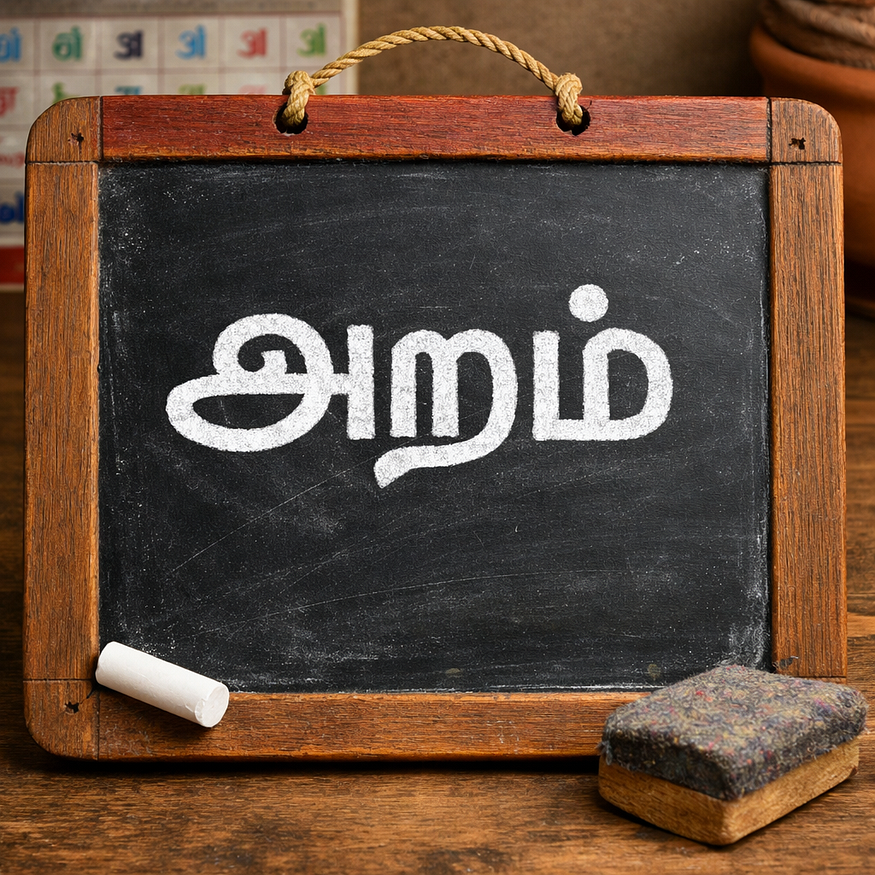
அறம் செய்ய விரும்பு. Aram Seyya Virumbu.
Have a desire (virumbu) to engage (Seyya) in righteous conduct (aram).
This is the first line from Aathichoodi, a collection of Tamil moral aphorisms by the poetess-saint Avvaiyar (1st century BCE). Aathichoodi is also prominent among the early literature on righteous conduct introduced to children in Tamil Nadu.
In the long history of sages, philosophers, and visionaries across cultures, one recurring theme is the importance of being righteous, especially through Ahimsa, as a path to liberation.
In this rapidly changing world, why is this advice timeless? Are we slated for a change?
To understand this, we must understand the nature of most of our problems.
“All problems are interpersonal,” said Alfred Adler.
I remembered being enamored by this statement when I read it in the book, “The Courage To Be Disliked” by Ichiro Kishimi and Fumitake Koga.
Simple and clean. The specifics may vary, but the core problem is identified.
But, what is the solution?
A message from the bed of arrows
Bhishma Pitamaha, on his deathbed, gave a solution.

अहिंसा परमो धर्मः| Ahimsa Paramo dharmaha||
[Full shloka at the end of this article]
Ahimsa, non-violence.
Why specifically Ahimsa? How does Ahimsa solve problems?
Also, why is it the foremost dharma?
Harmony in relationships
Interpersonal rules like Ahimsa are the foundation of social harmony, making them the first order of business for a peaceful society. Patanjali Muni also identifies this value in his Yoga Sutras, where he discusses yama as the first path towards liberation.
अहिंसासत्यास्तेयब्रह्मचर्यापरिग्रहा: यमाः॥ Ahiṃsa-satya-asteya-brahmacarya-aparigrahā yamāḥ||2.30॥
Ahimsa (non-violence), Satya (truthfulness), Asteya (non-stealing), Brahmacharya (keeping brahman as the theme), and Aparigraha (non-acceptance) are yama (interpersonal rules).
Although the Bhagavata Purana (11.19.33) adds more values, Ahimsa continues to remain the foremost, underscoring its timeless importance across traditions.
But why did interpersonal rules (yama) precede personal rules (Niyama)? How we treat others is somehow more important than how we are with ourselves, for it precedes Niyama in the list. Let’s take a look at Niyama.
शौचसन्तोषतपःस्वाध्यायेश्वरप्रणिधानानि नियमाः॥ shaucha-santosha-tapah-svaadhya-eshvarapranidhanani niyamaaha ||2.32॥
Shauca (Cleanliness), santosha (Contentment, being happy with what you have), tapas ( Austerity or Devotion without applause), svaadhyaaya (Study and Recitation of Sacred Scriptures), Eshvara pranidhaanaani (Surrendering the fruits of actions to the Lord, trusting that which is unfolding without gripping the outcome) are personal rules.
It seems to me that hurting others is, by more than a factor of two, a bigger problem than just hurting oneself!
Again, in the textbooks of Ayurveda
Scholar-physician Acharya Vagbhata around the 7th century CE in his Astanga Hrudaya says,
हिंसास्तेयान्यथाकामं पैशुन्यं परुषानृते||२१||
सम्भिन्नालापं व्यापादमभिध्यां दृग्विपर्ययम्|
पापं कर्मेति दशधा कायवाङ्मानसैस्त्यजेत् ||२२||
hiṁsā steyānyathākāmaṁ paiśunyaṁ paruṣānṛte ||21||
sambhinnālāpaṁ vyāpādam abhidhyāṁ dṛgviparyayam |
pāpaṁ karmeti daśadhā kāyavāṅmānasais tyajet ||22||
Himsa (violence), steya (theft), anyataakaamam (illicit sexual indulgence), paaishunyam (slander), parusha (harsh speech), anruta (falsehood), sambhinnaalaapam (divisive talk), vyaapaadam (quarrel), abhidhyam (jealousy), drgviparyayam (faultfinding) — are thus (iti) ten-fold (dashadaa) sinful actions (paapam karma) altogether, committed through body (kaaya), speech (vaak), and mind (manas), that should be renounced (tyajet).
He again identifies himsa (violence) commited by body-speach-mind as the biggest sin.
Oneness of the prescription
There are many such instances of consistency across Indian shastras and experiences through the ages. Take, for instance, the path to liberation.
🪷In Ashtanga yoga, Patanjali Muni lists the eight fold path thus:
यमनियमासनप्राणायामप्रत्याहारधारणाध्यानसमाधयोऽष्टावङ्गानि|| (2.29)
Yama-Niyama-Āsana-Prāṇāyāma-Pratyāhāra-Dhāraṇā-Dhyāna-Samādhayo’ṣṭāvaṅgāni
Social conduct (Yama), Personal observances (Niyama), Steady-comfortable posture (Asana), Breath control (Pranayama), Withdrawal of senses (Pratyahara), One-pointed concentration (Dharana), Meditation (Dhyana), and Surrender to the One (Samadhi)
🪷Last week, as I was studying under my Guru, another subtlety showed up in Bhagavatam. Maitreya beautifully describes Dhruva’s sadhana thus:
तस्या विशुद्धकरण: शिववार्विगाह्य बद्ध्वाऽऽसनं जितमरुन्मनसाऽऽहृताक्ष: ।
स्थूले दधार भगवत्प्रतिरूप एतद् ध्यायंस्तदव्यवहितो व्यसृजत्समाधौ ॥4.12.17॥
tasyā viśuddhakaraṇaḥ śivavārvigāhya baddhvāsanaṃ jitamarunmanasāhṛtākṣaḥ |
sthūle dadhāra bhagavatpratirūpa etad dhyāyaṃstadavyavahito vyasṛjatsamādhau ||
अन्वयक्रम: — तस्याम् (गङ्गायां) शिववारि अवगाह्य, विशुद्धकरण:, जितमरुत्, आसनं बद्ध्वा,मनसा आहृताक्ष, भगवत्प्रतिरूपे स्थूले दधार| एतद् ध्यायन् समाधौ अव्यवहित: तत् विसृजत्||
Having become clean in mind (vihuddhakaranaha) from bathing (avagaahya) (in Ganga), engaging in breath control (jitamarunt), taking an asana (baddhvaasanam), by mind withdrawing his senses (manasaahrutakshaha), on Paramaatma’s gross form (bhagavatpratirupe), fixed/ meditated(dadhara). Meditating (dhyaayan) on this gross (sthula) form, in the state of oneness (samadhi), transcended (avyavahita) that form (meaning: he began meditating on the bimba form residing in the heart).
🪷 In recent times, the well-documented journey of Sri. Ramakrishna Paramahamsa, who entered nirvikalpa samadhi, also follows a similar route.
Let’s revisit the original question
What is Ahimsa, and will it remain important in the days to come?
Many vegans and vegetarians view Ahimsa as more than just abstaining from eating meat. But in reality, its roots run deep. It embodies a heightened sensitivity to all forms of life — non-violence in our thoughts, feelings, and actions.
Why is Ahimsa considered paramount? How is it directly connected to our survival?
Upholding Ahimsa in our daily interactions fosters a sense of ease. Without which, our minds’ constant vigilance can distort our view of the world, making it harder to see the good that exists. Instead of fostering understanding, it breeds fear and conflict.
Also, this feeling of ease is the foundation of our ability to focus on any task. Imagine what happens to us when we practice himsa (violence) or perceive threats. We trap ourselves in the relentless production of cortisol (the stress hormone), pushing all our organs to their edge, endangering our own existence.
Practiced in its truest essence, Ahimsa, thus, not just guarantees the well-being of the world, but also makes its practitioner the primary beneficiary of this virtue.
The path forward
How can we apply Ahimsa in our daily lives through our thoughts, feelings, and actions? This topic has been explored extensively, and you may already have some ideas in mind.
Here are some less obvious ways to foster an environment of ease through Ahimsa:
– By striving to understand the intentions of others.
– By refraining from saying things that may hurt others.
– By not taking things too personally, allowing everyone the space to navigate their own journey toward progress in harmony.
Back to the first reference. This is a good time to learn the full verse.
In Mahabharata 13.117.37–38 where Bhīṣma tells Yudhiṣṭhira about ahimsa. It goes like this:
अहिंसा परमो धर्म: तथाहिंसा परो दमः|
अहिंसा परमं दानम् अहिंसा परम् तपः|| ३७||
अहिंसा परमो यज्ञ: तथाहिंसा परं बलम्|
अहिंसा परमं मित्रम् अहिंसा परमं सुखम्|
अहिंसा परमं सत्यम् अहिंसा परमं श्रुतम्|| ३८||
Non-violence is the supreme righteousness (Dharma), and non-violence is the supreme discipline (Dama)
Non-violence is the supreme charity (Daanam), non-violence is the supreme austerity (Tapa)
Non-violence is the supreme sacrifice (Yajna), and non-violence is the supreme strength (Bhalam)
Non-violence is the supreme friend (Mitram), non-violence is the supreme happiness (Sukham)
Non-violence is the supreme truth (Satyam), non-violence is the holy writ (Shrutam).
Many generations share the same earth at the same time, yet experience life differently. The specifics of the problems vary, but I’m more convinced that ever that Ahimsa will pass any Gen any-greek-letter’s “Aura” vibe check and continue to bind us to our humanity. How do you follow Ahimsa in your life?
पुन: मिलामः (let’s meet again)
श्रीकृष्णार्पनमस्तु|🪷




Leave a Reply